
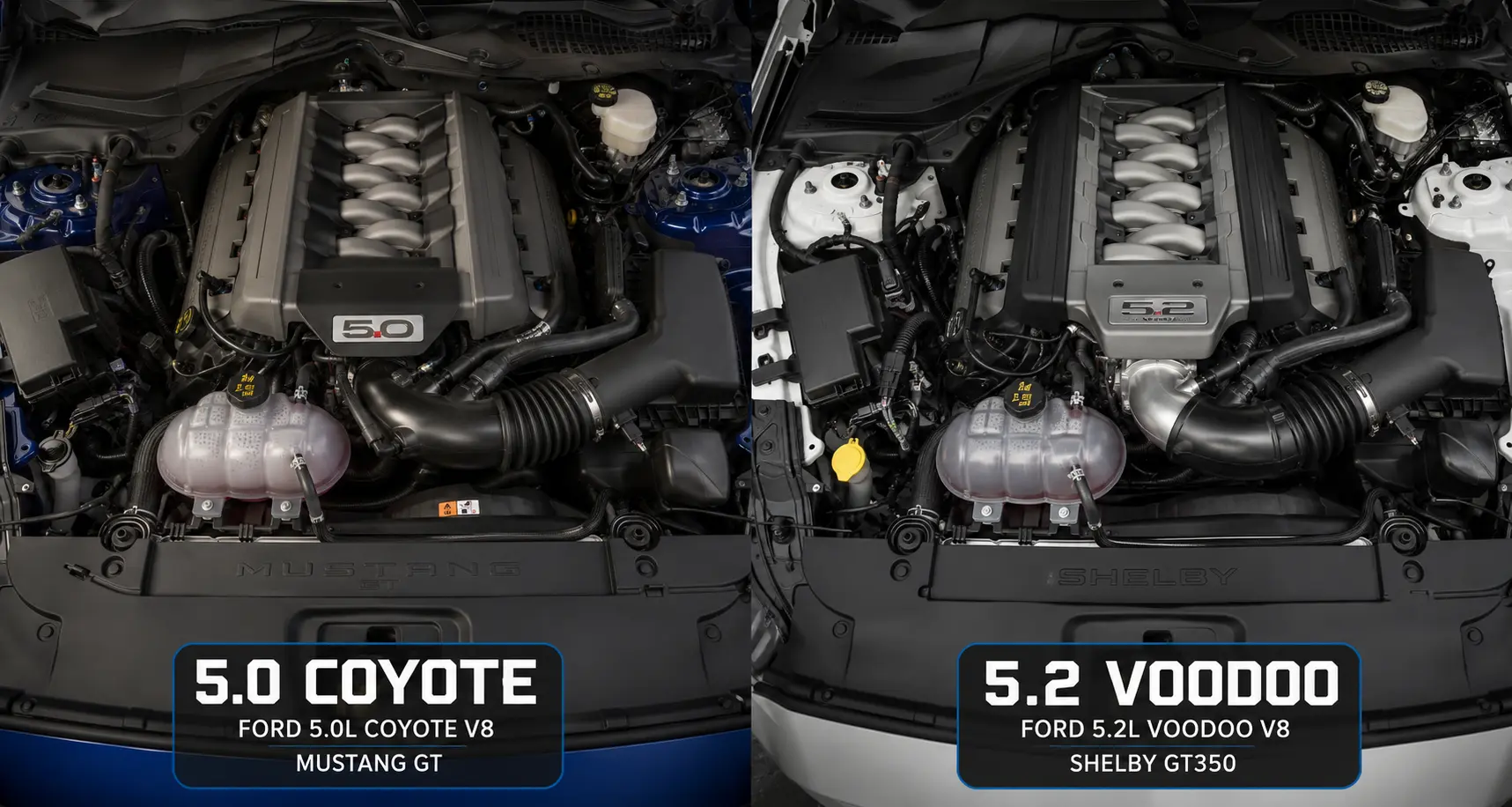
Most comparisons between the 5.0 Coyote and the 5.2 Voodoo start and end with horsepower numbers. Five hundred twenty-six versus four-eighty. The Voodoo wins by forty-six horsepower, case closed. But that framing misses what makes the Voodoo one of the most mechanically interesting production V8 engines ever built by an American manufacturer — and it misses why the Coyote, for all its tunability and daily-driver friendliness, is a fundamentally different machine. These two engines share a family name and a factory. They do not share a philosophy.
This article goes past the spec sheet and into the geometry, the physics, and the engineering decisions that explain why the Voodoo pulls to 8,250 rpm like a Ferrari and why the Coyote makes more sense in your daily-driver Mustang GT. By the time you finish reading, you will understand bore-stroke ratios, rod ratios, breathing frequency, flat-plane vs cross-plane dynamics, and why those numbers — not the dyno sheet — are what define these engines.
Both engines are nearly square on bore and stroke. Run the numbers yourself with our engine displacement calculator — then compare mean piston speed at redline using the stroke values in Table 2 below.
First, the confirmed numbers side by side
Before getting into the engineering, here are the verified specs you need as a reference point throughout the article.
| Spec | 5.0 Coyote (Gen 3, 2018+) | 5.2 Voodoo (2016–2020) |
|---|---|---|
| Displacement | 5.035L / 307 ci | 5.163L / 315 ci |
| Bore | 93.0 mm / 3.661 in | 94.0 mm / 3.700 in |
| Stroke | 92.7 mm / 3.649 in | 93.0 mm / 3.661 in |
| Bore/Stroke Ratio | 1.003:1 (nearly square) | 1.011:1 (slightly oversquare) |
| Compression Ratio | 12.0:1 | 12.0:1 |
| Connecting Rod Length | 5.933 in | 5.933 in |
| Rod Ratio (rod ÷ stroke) | 1.625:1 | 1.621:1 |
| Crankshaft Type | Cross-plane (90°) forged steel | Flat-plane (180°) forged steel |
| Valvetrain | DOHC, 4V per cylinder, Ti-VCT | DOHC, 4V per cylinder, Ti-VCT |
| Valve — Intake Diameter | 37.7 mm / 1.48 in | Larger — Voodoo-specific head |
| Firing Order | 1-5-4-8-6-3-7-2 | 1-5-4-8-6-3-7-2 |
| Peak Horsepower | 460 hp @ 7,000 rpm | 526 hp @ 7,500 rpm |
| Peak Torque | 420 lb-ft @ 4,600 rpm | 429 lb-ft @ 4,750 rpm |
| Redline | 7,500 rpm | 8,250 rpm |
| Fuel System | Port + Direct injection (dual) | Sequential multi-port injection |
| Main Caps | Cross-bolted | 5-bolt mains |
| Oiling (GT350R) | Wet sump | Dry sump (Track Package) |
| Assembly | Windsor Engine Plant | Hand-built, Ford Romeo Niche Line |
| Applications | Mustang GT, F-150, others | Ford Mustang Shelby GT350 / GT350R only |
| Production Years | 2018–present (Gen 3) | 2016–2020 only |
| Total Voodoo Production | — | ~24,000 units across both models |
Now let us explain what those numbers actually mean.
Bore and stroke: the geometry of power
The relationship between bore diameter and stroke length is one of the most fundamental design decisions in any engine. It determines where in the rpm range the engine makes its best power, how it breathes, how hot it runs, and how high it can rev before mechanical limits catch up with it.
Bore is the diameter of the cylinder. Stroke is how far the piston travels from bottom dead center to top dead center. When bore and stroke are equal, the engine is called "square." When bore is larger than stroke, it is "oversquare" or "short-stroke." When stroke is larger than bore, it is "undersquare" or "long-stroke."
The Coyote Gen 3 runs a bore of 93.0 mm and a stroke of 92.7 mm — essentially square, with a ratio of 1.003:1. The Voodoo runs 94.0 mm bore and 93.0 mm stroke — 1.011:1, barely oversquare. On paper these look nearly identical. But the implications compound quickly when you factor in piston speed, head flow, and the flat-plane crankshaft.
The key formula here is mean piston speed. At any given rpm, a longer-stroke engine moves its pistons faster. Faster pistons generate more heat, more friction, and hit mechanical stress limits at lower rpm. Shorter-stroke engines keep piston speeds manageable at higher rpm, which is one reason oversquare engines tend to have higher redlines. The difference between the Coyote's 3.649-inch stroke and the Voodoo's 3.661-inch stroke is only 0.012 inches — barely a credit card's thickness. Alone, that is not what separates their redlines by 750 rpm. The crankshaft is what does that.
| Engine | Stroke (in) | Redline (rpm) | Mean Piston Speed (ft/min) |
|---|---|---|---|
| 5.0 Coyote Gen 3 | 3.649 | 7,500 | ~4,561 |
| 5.2 Voodoo | 3.661 | 8,250 | ~5,028 |
| Formula 1 engine (ref.) | ~1.97 | 15,000+ | ~4,925 |
Mean piston speed formula: (2 × stroke in feet × rpm). Values rounded. F1 reference for context only. Convert torque and rpm to horsepower with our HP from torque calculator.
The Voodoo's pistons are moving faster at its 8,250 rpm redline than the Coyote's at 7,500. Ford made this work through bottom-end engineering — forged Manley billet steel connecting rods, forged steel crankshaft, 5-bolt main caps — but the primary enabler of that high redline is not the short stroke. It is the flat-plane crankshaft's effect on reciprocating mass balance and its influence on how the engine breathes.
The flat-plane crankshaft: not a gimmick
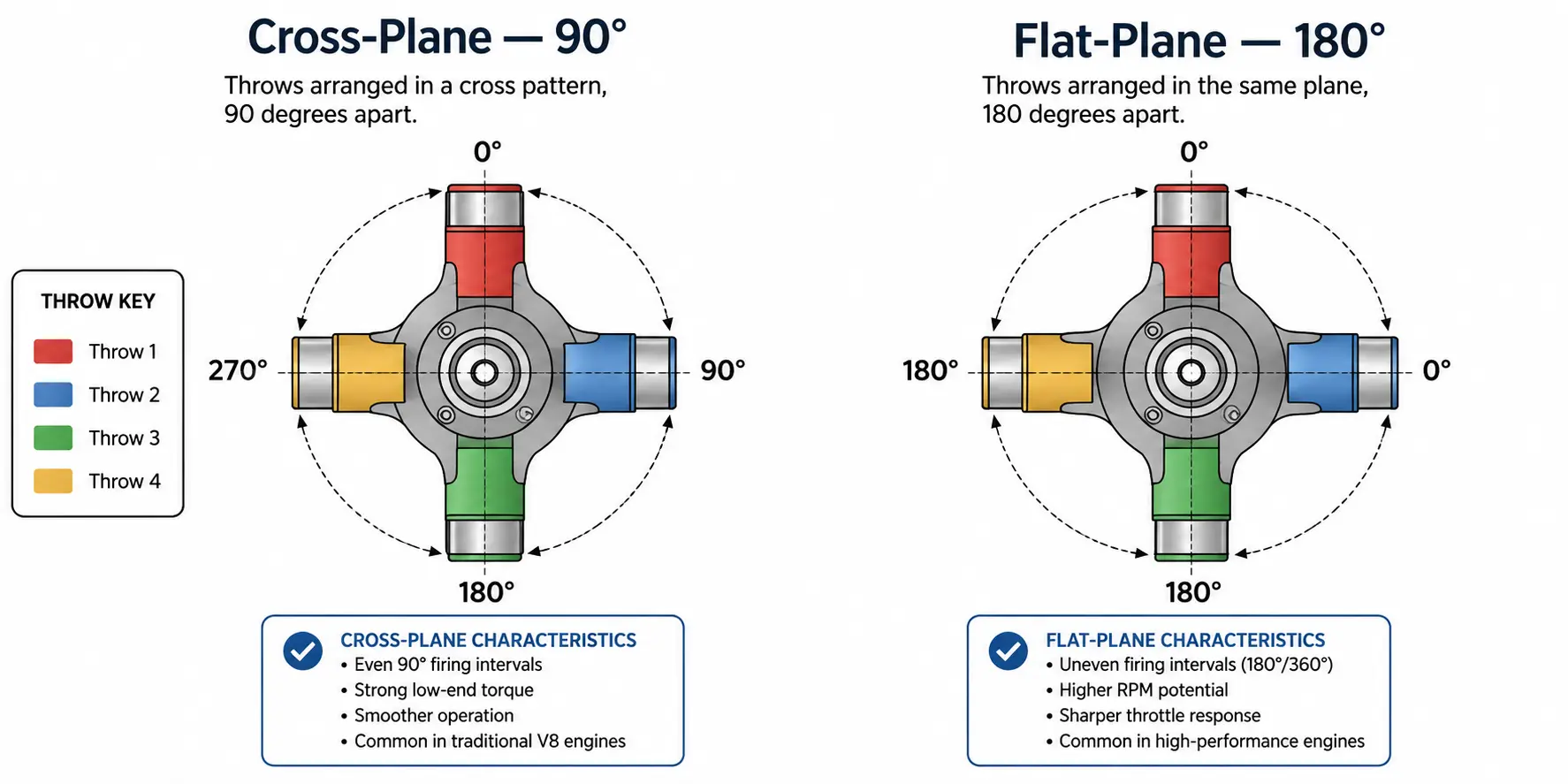
Most American V8s use a cross-plane crankshaft. Looking down the engine's centerline from the front, the four crank throws are arranged 90 degrees apart from each other — forming a cross shape. This configuration naturally balances primary and secondary forces from the eight pistons moving up and down, which produces a smooth idle and low vibration. Your grandparents' Buick had one. The Coyote has one. Most V8s in existence have one.
The Voodoo has a flat-plane crankshaft. The four crank throws are arranged 180 degrees apart — all in the same plane. This is how Ferrari builds its V8s, and it was not a coincidence that Ford purchased a Ferrari California during Voodoo development and used it as a benchmark.
The flat-plane design creates uneven firing intervals between cylinder banks. In a cross-plane engine, each bank of four cylinders fires in an alternating pattern that spaces out exhaust pulses evenly. In a flat-plane engine, both banks fire in sequence — left bank fires, then right bank fires, then left bank again. Exhaust pulses from the same bank arrive at the collector back-to-back rather than alternately spaced.
This matters for two reasons. First, it makes the exhaust scavenging more aggressive. When a cylinder is done with its exhaust stroke, the negative pressure wave from the previous cylinder's exhaust pulse can help pull remaining exhaust gases out and draw in fresh charge. Done right, flat-plane firing creates better cylinder breathing at high rpm. Second, it changes the sound entirely. The alternating left-right-left-right exhaust cadence is gone, replaced by the rapid burbling scream that GT350 owners and Ferrari owners know well — a sound that became a signature of the car.
The downside is vibration. A flat-plane crank does not cancel out the same forces a cross-plane crank does. The primary forces from opposing pistons cancel, but secondary forces do not. In a street car, this means you feel the engine through the steering wheel and seat at certain rpm ranges. Ford mitigated this with specific engine mounts and tuning, but the Voodoo is still noticeably more characterful at idle and low rpm than the smooth Coyote. The SAE noted in 2014 that flat-plane designs above 4.6 liters can create significant vibration challenges — Ford pushed past that to 5.2 liters, which is a large part of why the Voodoo took the engineering resources it did.
| Characteristic | Cross-Plane (Coyote) | Flat-Plane (Voodoo) |
|---|---|---|
| Crank throw angle | 90° apart | 180° apart |
| Firing interval (each bank) | Alternating — even spacing | Sequential — back-to-back same bank |
| Primary balance | Excellent | Good |
| Secondary balance | Good | Requires counterweights / tuning |
| Exhaust scavenging | Moderate | Aggressive at high rpm |
| Crank weight | Heavier (counterweights) | Lighter — less rotational mass |
| Rev response | Smooth, progressive | Faster, more reactive |
| Idle character | Smooth | Pronounced lope/burble |
| Sound character | Traditional American V8 | European/exotic high-rpm scream |
| Common in | Most American V8 production engines | Ferrari V8s, GM LT6, race engines |
| Vibration at street rpm | Minimal | Noticeable — by design |
The lighter rotating assembly is significant beyond just vibration. Less rotational mass means the engine accelerates through its rpm range faster. When you press the throttle on a GT350 at 4,000 rpm, the engine does not build to the next thousand rpm — it lunges there. This throttle sharpness is a direct result of the flat-plane crank's reduced reciprocating mass, and it is something no tune or intake swap can replicate on the cross-plane Coyote.
Rod ratio: what it does and why both engines land where they do
Rod ratio is connecting rod length divided by stroke. The Voodoo uses a 5.933-inch rod on a 3.661-inch stroke, giving a ratio of 1.621:1. The Coyote uses the same rod on a 3.649-inch stroke — 1.625:1. They are essentially identical.
Rod ratio affects piston dwell time at top dead center, side loading on the cylinder walls, and the angularity of the rod during the power stroke. A longer rod relative to stroke means the piston spends more time near TDC — giving the combustion event more time to build cylinder pressure before the piston retreats and the expansion ratio drops. It also reduces the angle the rod makes to the cylinder wall at mid-stroke, which reduces friction and side load on the piston skirt.
The Ford Modular engine family — and that includes both the Coyote and the Voodoo — inherits a rod length of 5.933 inches that traces back to the original 4.6L modular. Ford has kept this dimension consistent across the family for packaging and parts-sharing reasons. At 1.62:1, both engines sit in a respectable performance range. High-output naturally aspirated race engines often target ratios above 1.75:1, but pushing rod ratio up requires either a shorter stroke or a taller deck — both of which have their own tradeoffs in a production engine package.
Head flow and breathing frequency
The Voodoo head is not the Coyote head. While the two engines share the modular engine family's bore spacing of 3.937 inches, the Voodoo uses a cylinder head that was developed specifically for its application. The ports are larger. The combustion chamber is optimized for the flat-plane firing order's exhaust timing. The valvetrain is tuned for high-rpm operation.
Breathing frequency is where this gets interesting. Every time a cylinder opens its intake valve, a pressure wave travels down the intake runner, bounces off the plenum, and returns. If the wave returns at exactly the right moment — when the intake valve is still open — it rams additional air charge into the cylinder. This is called intake resonance or ram tuning, and it is how naturally aspirated engines get a torque peak at a specific rpm. The length of the intake runner determines what rpm this happens at. Longer runners favor low rpm torque. Shorter runners favor high rpm power.
Ford claims 90 percent of the Voodoo's peak torque is maintained from 3,450 to 7,000 rpm. That is a wide, flat torque curve that does not fall off dramatically as rpm climbs — exactly what you want in a track car where the engine is living between 5,000 and 8,000 rpm in a corner. The flat torque curve is a product of the head design, the cam timing, and the exhaust tuning working together with the flat-plane crank's exhaust scavenging.
| Characteristic | 5.0 Coyote | 5.2 Voodoo |
|---|---|---|
| Peak torque | 420 lb-ft @ 4,600 rpm | 429 lb-ft @ 4,750 rpm |
| Peak horsepower | 460 hp @ 7,000 rpm | 526 hp @ 7,500 rpm |
| Usable torque band (factory claim) | Broad low-mid range | 90% of peak from 3,450–7,000 rpm |
| HP per liter | ~91 hp/L | ~102 hp/L |
| HP per cubic inch | ~1.50 hp/ci | ~1.67 hp/ci |
| Power character | Strong from idle, builds progressively | Builds urgently above 4,500 rpm |
| Best use case | Street, drag, daily tuner platform | Road course, high-rpm canyon |
The Coyote's dual fuel injection — port and direct injection together on Gen 3 — is worth noting here too. Port injection sprays fuel into the intake port, helping keep the back of the intake valves clean (a known carbon buildup issue with direct-injection-only engines). Direct injection allows for precise fueling and enables the 12:1 compression ratio on 91 octane. The Voodoo uses port injection only, which keeps the system simpler but loses the carbon-cleaning benefit of port injection. Both compress at 12:1 — model static compression with our compression ratio calculator.
The block itself: not a bored-out Coyote
A common misconception is that the Voodoo is simply a Coyote that Ford bored and stroked to 5.2 liters. It is not. The Voodoo uses a new block with a thicker deck to handle the structural demands of the flat-plane crank's vibration characteristics and the engine's sustained high-rpm operation. The oiling system was revised as well — the GT350R with the Track Package uses a dry-sump oiling system to maintain oil pressure during the lateral g-loads of road course driving, where a wet-sump engine can starve for oil in sustained corners. The GT350 without the Track Package uses a wet sump.
Every Voodoo was hand-built at Ford's Romeo Niche Line in Michigan — the same facility responsible for other Ford Performance engines. Approximately 24,000 units were produced across the full run of both models from 2016 to 2020. When Ford discontinued the Ford Mustang Shelby GT350 and replaced it with the GT500, the flat-plane Voodoo was replaced by the 5.2 Predator — same bore, same stroke, same displacement, but a cross-plane crank and a Roots-type Eaton TVS R2650 supercharger. The Predator makes 760 horsepower and 625 lb-ft. It is a different kind of fast.
Why the Coyote tunes so well and the Voodoo does not need to
The Coyote is one of the most popular engine swap and tuning platforms in modern performance history. A stock Gen 3 Coyote with a tune, intake, and exhaust can push past 500 horsepower reliably. Add a supercharger and the forged bottom end will hold 700 to 800 horsepower with supporting mods. The cross-plane design, broad torque curve, and flexible fuel system make it an extremely cooperative platform.
The Voodoo was not designed as a tuner platform. It was designed to be as close to a race engine as Ford could legally sell in a street car. Simple bolt-ons — tune, intake, headers, exhaust — can move a Voodoo to 580 or 600 horsepower at the crank. But the flat-plane crank limits how far forced induction can go without specialized tuning to manage the vibration characteristics under boost. The Voodoo's value proposition is what it does stock, at 7,500 rpm, on a road course, for five consecutive laps without the oil temperature climbing into crisis territory.
| Modification Level | 5.0 Coyote (est. crank hp) | 5.2 Voodoo (est. crank hp) |
|---|---|---|
| Stock | 460 hp | 526 hp |
| Tune + intake + exhaust | 490–510 hp | 560–590 hp |
| Headers + tune + cold air | 500–530 hp | 580–610 hp |
| Heads + cams (naturally aspirated) | 550–600 hp | 620–660 hp |
| Roots/centrifugal supercharger | 650–800 hp (stock block) | Possible but complex — crank dynamics |
| Built motor + forced induction | 900–1,200+ hp | 700–900 hp (specialized build) |
Estimates based on commonly reported community results. Individual results vary by supporting mods, tune quality, and ambient conditions.
The number that defines the Voodoo: 8,250
The 8,250 rpm redline of the Ford 5.2 Voodoo is the highest factory redline ever set on a production V8 by an American automaker. That is not marketing copy — it is an engineering achievement that required a flat-plane crankshaft, a purpose-built block, hand-assembled tolerances at the Romeo Niche Line, and cylinder heads developed in part by benchmarking a Ferrari California. No other American production V8 has turned that number from the factory.
To put it in context: a Gen 3 Coyote redlines at 7,500. A Chevrolet LS3 redlines at about 6,600. The Dodge 392 HEMI redlines around 6,400. The LT6 in the Corvette Z06 — itself a flat-plane crank engine and the only modern American V8 to approach the Voodoo's character — redlines at 8,600, but it arrived five years after the GT350 was discontinued.
The Voodoo did not win the horsepower arms race. It never tried to. What it did was prove that an American manufacturer could build a naturally aspirated, high-compression, flat-plane V8 that revved like a European exotic, sounded unlike anything else in a showroom under $80,000, and turned laps as a legitimate road course weapon. The spec sheet shows 526 horsepower. What it cannot show is what happens between 6,500 and 8,250 rpm when the exhaust note crosses into something that makes no rational sense coming out of a Mustang.
Related pages
ENGINE DISPLACEMENT
Calculate cubic inches and liters from bore, stroke, and cylinder count.
HP FROM TORQUE
Convert factory torque and rpm figures into horsepower — the math behind the dyno sheet.
GEAR & RPM
See where 7,500 and 8,250 rpm land in each gear on the street or track.
Engine specifications sourced from Ford factory documentation and commonly published SAE-rated figures. Tuning estimates reflect widely reported community results; individual builds vary.