
What Is the 1970 Mustang SportsRoof?
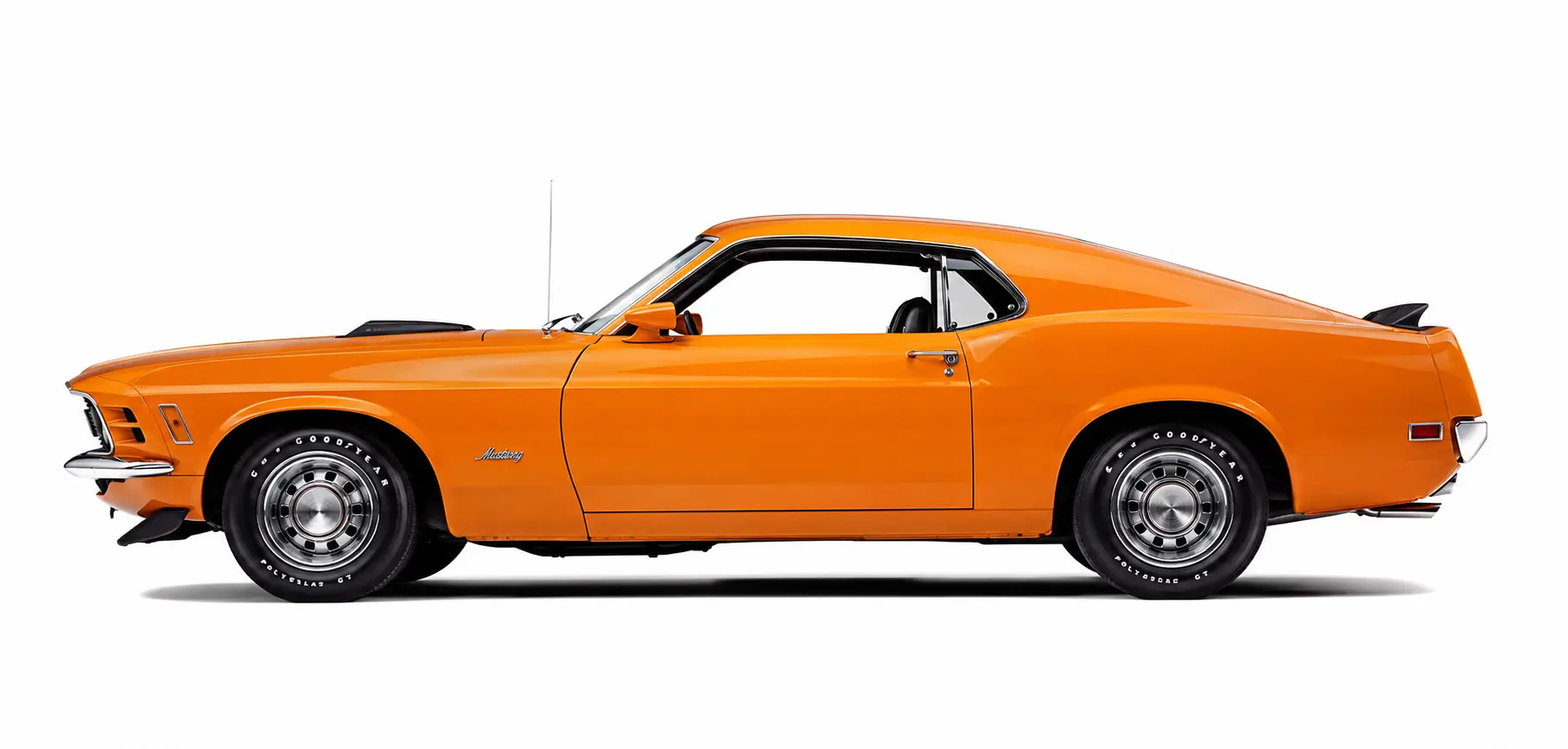
The 1970 Ford Mustang SportsRoof is Ford's factory designation for the fastback body style in what many historians consider the final year of the "pure" first-generation Mustang. Ford officially called it the SportsRoof — not fastback — to emphasize its swept-back roofline and sporty character. The nameplate appeared on the door data plate and in all factory documentation.
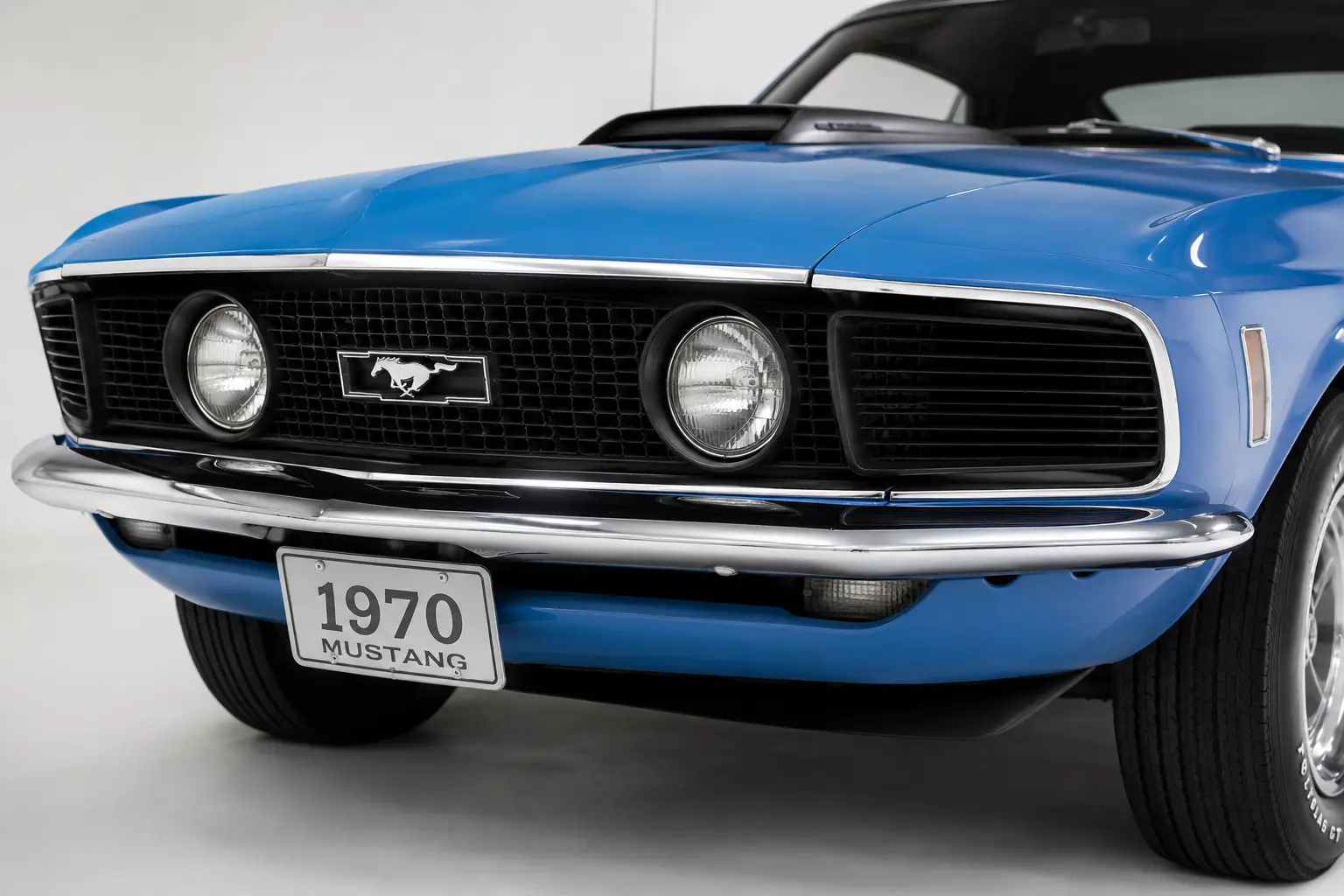
The 1970 model year carried over the substantially redesigned 1969 platform with targeted visual refinements, most notably moving the headlights inboard into the grille opening and deleting the rear quarter windows that had been an optional louvered feature on the 1969 SportsRoof. The result was a slightly cleaner, more aggressive look than its predecessor.
It was also a historically significant year for performance: 1970 marked the last time Ford offered both the Boss 302 and Boss 429 in the same model year. Within two years, tightening emissions standards, rising insurance rates, and the energy crisis would end the muscle car era as the industry knew it.
Quick Identification Fact
On a 1970 Mustang SportsRoof, the VIN body code is 02 (base SportsRoof) or 05 (Mach 1 SportsRoof). The Mach 1 was a separate model designation, not just a trim package — it carries body code 05 in the VIN, not 02.
Dimensions & Body Specs
The 1970 SportsRoof shared its platform with the 1969 model. The wheelbase remained 108 inches — a figure that had defined the first-generation Mustang since 1965. All measurements below are factory figures from Ford's AMA specification sheets.
| Dimension | Measurement | Notes |
|---|---|---|
| Wheelbase | 108.0 in (2,743 mm) | Unchanged from 1965 original |
| Overall Length | 187.4 in (4,760 mm) | Same as 1969 |
| Overall Width | 71.3–74.1 in | Varies by source/mirror config |
| Overall Height | ~50.4 in (1,280 mm) | SportsRoof (lower than hardtop) |
| Curb Weight (base) | ~2,721–3,240 lb | Varies widely by engine/options |
| Front Track | 58.5 in | Standard suspension |
| Rear Track | 58.5 in | Standard suspension |
| Fuel Tank | 20 gallons | Standard |
| Body Style | 2-door fastback coupe | VIN code 02 (base) / 05 (Mach 1) |
| Body Code | 63A / 63B | 63A = standard; 63B = Mach 1 |
| Standard Tires | C78-14 4-ply blackwall | E70-14 or F70-14 on Boss/Mach 1 |
Source: Ford 1970 AMA Specification Sheet; conceptcarz.com
Note that the 1971 Mustang grew dramatically — over 2 inches longer, nearly 2.5 inches wider, and more than 400 lbs heavier — making the 1970 the last of the compact-feeling SportsRoofs before Ford's controversial enlargement of the platform.
All Engine Options & Codes
The 1970 Mustang offered a broad powertrain menu — from the base 200ci inline-six through the fire-breathing Boss 429. Every engine had a unique single-letter code stamped in the VIN (position 5) and on the door data plate. These codes are the fastest way to confirm what engine a 1970 Mustang was built with.
| VIN Code | Engine | Displacement | Carb | HP (Gross) | Torque | Type |
|---|---|---|---|---|---|---|
| T | Inline 6 (Thriftpower) | 200 ci / 3.3L | 1V | 120 hp @ 4,400 rpm | 190 lb-ft | Standard / Base |
| L | Inline 6 | 250 ci / 4.1L | 1V | 155 hp @ 4,400 rpm | 240 lb-ft | Optional 6-cyl upgrade |
| F | Windsor V8 | 302 ci / 5.0L | 2V | 220 hp @ 4,600 rpm | 300 lb-ft | Optional V8 base |
| H | 351 Windsor or 351 Cleveland V8 | 351 ci / 5.8L | 2V | 250 hp @ 4,600 rpm | 355 lb-ft | Optional — both blocks used early in MY |
| G | Boss 302 V8 | 302 ci / 5.0L | 4V Holley | 290 hp @ 5,800 rpm | 290 lb-ft | Boss 302 only — competition engine |
| M | 351 Cleveland V8 | 351 ci / 5.8L | 4V | 300 hp @ 5,400 rpm | 380 lb-ft | New for 1970 — high-perf option |
| Q | 428 Cobra Jet V8 | 428 ci / 7.0L | 4V | 335 hp @ 5,600 rpm | 440 lb-ft | Cobra Jet (non-Ram Air) |
| R | 428 Super Cobra Jet V8 | 428 ci / 7.0L | 4V Ram Air | 335 hp @ 5,600 rpm | 440 lb-ft | Cobra Jet with Ram Air induction; drag pack available |
| Z | Boss 429 V8 | 429 ci / 7.0L | 4V Holley | 375 hp @ 5,200 rpm | 450 lb-ft | Boss 429 SportsRoof only — last year offered |
Sources: mustangattitude.com; carmemories.com; classicindustries.com VIN decoder; Ford 1970 AMA spec sheet
Important Note on H-Code Engines
The H-code 351/2V engine is unique in 1970: early production used the 351 Windsor block, while later production switched to the new 351 Cleveland block. Both carry the same H code in the VIN. To determine which block you have, check the engine pad stampings and casting date codes. The Cleveland uses a different block design with larger ports and canted valves.
Boss 302 vs Boss 429 — Key Differences
| Spec | Boss 302 (Code G) | Boss 429 (Code Z) |
|---|---|---|
| VIN Engine Code | G | Z |
| Displacement | 302 ci (4.9L) | 429 ci (7.0L) |
| Horsepower | 290 hp @ 5,800 rpm | 375 hp @ 5,200 rpm |
| Torque | 290 lb-ft @ 4,300 rpm | 450 lb-ft @ 3,400 rpm |
| Carburetor | Holley 4V | Holley 4V |
| Transmission | 4-speed manual (Hurst) | 4-speed manual only |
| Rear Axle | 3.50:1 non-locking std. | 3.91:1 or 4.30:1 Traction-Lok |
| Suspension | Competition (staggered rear shocks) | Competition — extensively modified front end |
| Brakes | Power front disc | Power front disc |
| Steering | Quick ratio 16:1 | Modified — Kar Kraft front end widening |
| Body Mods | Black hood, "C" stripes, rear spoiler opt. | Front end widened by Kar Kraft to fit block |
| 1970 Production | 7,013 units | 499 units |
| A/C Available? | No | No |
| Auto Trans? | No | No |
| Base Price (1970) | $3,720 | $4,932 |
Sources: hagerty.com; musclecarfacts.com; shnack.com; Wikipedia Boss 429 Mustang
Horsepower Comparison Chart
The chart below visualizes the full 1970 engine range from the base inline-six to the Boss 429, making it easy to see the horsepower jump between available options. Note that all ratings are SAE gross figures — the factory measurement standard of the era, which tended to run higher than the net figures used today.
Chart: 1970 Ford Mustang engine codes ranked by factory-rated gross horsepower. All figures SAE gross. ★ = Boss 429 was last offered in 1970.
Transmission Options
The 1970 SportsRoof came standard with a fully synchronized 3-speed manual with a floor-mounted shift lever. Several upgraded gearboxes were available depending on engine choice.
| Transmission | Type | Available With | Notes |
|---|---|---|---|
| 3-Speed Manual | Floor shift — standard | 6-cyl; 302 V8 | Base transmission on SportsRoof |
| 4-Speed Manual (Wide Ratio) | Floor shift, optional | V8 engines | Popular performance option |
| 4-Speed Manual (Close Ratio) — "Toploader" | Ford Toploader | High-perf V8s | Required on Boss 302 & Boss 429 |
| FMX Select-Shift Cruise-O-Matic | 3-speed automatic | 6-cyl ($191); 302/250hp 351 ($201); 351 CJ/428 ($222) | Not available on Boss 302 or Boss 429 |
Source: over-drive-magazine.com (1970 Ford Mustang AMA Fact Sheet); conceptcarz.com
VIN Decoder: How to Read Your 1970 Mustang VIN
The 1970 Mustang VIN is an 11-digit alphanumeric code stamped on a metal plate on the top edge of the dashboard on the driver's side, visible through the windshield. A matching certification label is on the rear face of the driver's door.
Sample VIN Breakdown — 0 F 02 M 100001
0 = 1970
Plant
Code
Code
Unit Number
VIN location: top of dashboard, driver's side, visible through windshield. Unit numbers begin at 100001. Diagram shows example VIN 0F02M100001 (1970 / Dearborn / Base SportsRoof / 351 Cleveland 4V).
Position-by-Position Reference
| Position | Meaning | Code | Description |
|---|---|---|---|
| 1 | Model Year | 0 | 1970 |
| 2 | Assembly Plant | F | Dearborn, Michigan |
| 2 | Assembly Plant | R | San Jose, California |
| 2 | Assembly Plant | T | Metuchen, New Jersey |
| 3–4 | Body Style | 01 | Hardtop Coupe |
| 3–4 | Body Style | 02 | Fastback / SportsRoof (base) |
| 3–4 | Body Style | 03 | Convertible |
| 3–4 | Body Style | 04 | Hardtop Grande (luxury) |
| 3–4 | Body Style | 05 | Fastback Mach 1 SportsRoof |
| 5 | Engine Code | T | 200ci I6 — 120 hp (standard) |
| 5 | Engine Code | L | 250ci I6 — 155 hp |
| 5 | Engine Code | F | 302ci V8 2V — 220 hp |
| 5 | Engine Code | H | 351ci V8 2V — 250 hp (Windsor or Cleveland) |
| 5 | Engine Code | G | 302ci V8 4V — 290 hp (Boss 302) |
| 5 | Engine Code | M | 351ci V8 4V — 300 hp (351 Cleveland) |
| 5 | Engine Code | Q | 428ci V8 4V — 335 hp (Cobra Jet) |
| 5 | Engine Code | R | 428ci V8 4V — 335 hp (Cobra Jet Ram Air) |
| 5 | Engine Code | Z | 429ci V8 4V — 375 hp (Boss 429) |
| 6–11 | Unit Number | 100001+ | Consecutive production number (starts at 100001) |
Sources: mustangattitude.com VIN matrix; carmemories.com; fastbackstack.com; classicindustries.com
Boss 429 VIN Note
Boss 429 Mustangs carry body code 02 in the VIN (standard SportsRoof), not a unique body code. They are identified by the Z engine code at position 5. The front end was heavily modified by Kar Kraft in Brighton, Michigan — the engine was so wide that Ford had to push the shock towers apart to fit it — but this modification does not appear in the VIN.
Production Numbers by Model (1970)
Total 1970 Mustang production was 190,727–191,239 units (slight variance across sources due to late-production adjustments). This represented a decline of approximately 5.5% year-over-year — the fourth consecutive year of declining Mustang sales as competition from the Camaro, Challenger, Barracuda, and Firebird intensified.
(Base)
(Base Fastback)
SportsRoof
Hardtop
SportsRoof
SportsRoof ★
★ Boss 429: final model year. Built by Kar Kraft. Total 1970 production: ~191,239 units. SportsRoof body styles account for roughly half of all 1970 Mustangs produced. Source: shnack.com / musclecarfacts.com
| Model | Body Code | Units Produced | Base Price (1970 USD) |
|---|---|---|---|
| Hardtop Coupe | 01 | 82,569 | ~$2,721 |
| SportsRoof (base fastback) | 02 | 45,934 | ~$2,771 |
| Mach 1 SportsRoof | 05 | 40,970 | ~$3,271 |
| Grande Hardtop | 04 | 13,581 | ~$3,028 |
| Convertible | 03 | 7,673 | ~$3,025 |
| Boss 302 SportsRoof | 02 + G code | 7,013 | $3,720 |
| Boss 429 SportsRoof | 02 + Z code | 499 | $4,932 |
Sources: shnack.com; musclecarfacts.com; mustangspecs.com; hagerty.com
SportsRoof models (base + Mach 1 + Boss 302 + Boss 429) totaled approximately 94,416 units — nearly half of all 1970 Mustang production.
SportsRoof Model Variants
Not all 1970 Mustang SportsRoofs are the same. Ford offered four distinct SportsRoof configurations in 1970, each with its own VIN body code, standard features, and available options.
| Model | VIN Code | Engine (Standard) | Standard Features |
|---|---|---|---|
| SportsRoof (63A) | 02 | 200ci I6 120hp | 3-speed manual, floor shift, high-back bucket seats, loop-pile carpet, heater/defroster, courtesy lights, all-vinyl interior, curved side glass |
| Mach 1 (63B) | 05 | 351ci 2V V8 250hp | All SportsRoof features + honeycomb rear panel, grooved aluminum rocker moldings, die-cast Mach 1 badge, shaker hood option, competition suspension |
| Boss 302 | 02 + G | 302ci 4V 290hp | 4-speed Hurst, competition suspension, staggered rear shocks, power front disc brakes, quick-ratio steering 16:1, black hood, C-stripes, front spoiler, no auto/no A/C |
| Boss 429 | 02 + Z | 429ci 4V 375hp | 4-speed Toploader, Kar Kraft front-end widening, modified front spindles, power front disc brakes, Traction-Lok axle, no auto/no A/C; built at Kar Kraft Brighton MI |
Sources: mustangspecs.com; over-drive-magazine.com AMA fact sheet; hagerty.com
The Grabber SportsRoof Package
Early in the 1970 model year, Ford launched a marketing promotion called the "Grabber" to promote four new vivid exterior colors: Grabber Blue, Grabber Orange, Grabber Green, and Grabber Yellow. These colors were available only on the SportsRoof body style and could be paired with one of two stripe/tape packages. The Grabber promotion helped distinguish the 1970 model year visually and is a key identification point for collectors today.
Regional Specials: Twister & Sidewinder
Two limited regional specials were produced in 1970: the Twister Special — 96 Grabber Orange Mach 1s sold only in the Kansas City area, all with either the Super Cobra Jet Ram Air or the 351 Cleveland 4V, Drag Pack suspension, and a tornado fender decal. The Sidewinder Special was a similar regional promotion for the Oklahoma sales district, all 351-4V SportsRoofs built at Dearborn. Exact Sidewinder production numbers are not well documented.
Visual Identification: 1970 vs 1969 Mustang SportsRoof
The 1969 and 1970 SportsRoofs share the same basic body shell, and from a distance they look nearly identical. Here are the visual tells that distinguish a 1970 from a 1969 at a glance.
| Feature | 1969 SportsRoof | 1970 SportsRoof |
|---|---|---|
| Headlights | 4 lights — two inboard, two outboard in grille | 2 lights — single large light each side, inboard; outboard position is dummy intake |
| Rear Quarter Windows | Present (optional louvered) | Deleted entirely |
| Rear Tail Panel | Concave/recessed center panel | Flat tail panel between taillights |
| Rear Fender Vents | Simulated air extractors on rear quarter | Deleted — smooth quarter panel |
| Hood Pins | Twist-lock hood pins (Boss/performance) | Hood clips replaced hood pins on 1970 |
| GT Option | Available | Deleted — GT nameplate dropped after 1969 |
| 351ci Engine | Windsor only | Cleveland introduced mid-year; both used on H-code |
Sources: mustangspecs.com; hagerty.com; musclecarfacts.com
Grabber Colors & Paint Codes
The 1970 Mustang was offered in a wide range of colors. The four Grabber colors introduced that year were exclusive to the SportsRoof body style and became iconic identifiers of 1970 model year cars. The chart below lists the Grabber colors alongside their factory paint codes. For every 1970 factory color with hex swatches, see our 1970 first-generation paint code chart.
Grabber colors were exclusive to the SportsRoof body style in 1970. Color swatches are approximate representations — for exact restoration matching, use a period-correct factory paint chip reference. Source: mustangspecs.com
Note: exact factory paint codes for Grabber colors varied slightly by source documentation. For restoration-grade color matching, a Marti Report (issued by Marti Auto Works using Ford's original production database) will confirm the exact paint code your specific car was built with.
Collector Value & Rarity Guide
Among first-generation Mustangs, 1970 SportsRoof models are consistently strong performers at auction and in private sales. The rarity hierarchy is straightforward: engine code is the single biggest value driver, followed by documentation and originality. Use our Mustang price & inflation calculator to compare factory base MSRP against inflation-adjusted dollars for 1970 trims.
| Tier | Model / Code | Units Built | Rarity Notes |
|---|---|---|---|
| Tier 1 | Boss 429 (Z-code) | 499 | Last year of production. Built by Kar Kraft. Extremely rare. Highest collector premiums. Authenticity critical — Marti Report essential. |
| Tier 2 | 428 Super Cobra Jet Ram Air (R-code) | Low — not separately published | Ram Air Drag Pack cars are highly desirable. Separate production numbers not widely published; verify via Marti Report. |
| Tier 3 | Boss 302 (G-code) | 7,013 | Last year of Boss 302. Strong Trans-Am provenance. Correct numbers-matching cars command significant premiums. |
| Tier 4 | 428 Cobra Jet (Q-code) | Low — subset of fastback total | Big-block cars always command premium. Cobra Jet was the drag-strip staple. |
| Tier 5 | 351 Cleveland 4V (M-code) | Subset of fastback total | New for 1970. Very desirable in Mach 1 trim. Strong value, especially with Shaker hood. |
| Tier 6 | Base SportsRoof (T/L/F/H codes) | Majority of 45,934 | Entry-level collector cars. Strong resale if correct and documented. Widely available for restoration. |
Rarity tier is a general guide based on production numbers and market history. Always obtain a Marti Report for any serious purchase — it confirms engine, paint, transmission, and options as built.
Buyer's Note: Engine Swaps Are Common
The 1970 Mustang SportsRoof is one of the most commonly engine-swapped classic cars in existence. A car presented as a "Boss 302" or "Cobra Jet" should always be verified with a Marti Report from Marti Auto Works, which cross-references Ford's original production records. The VIN alone does not guarantee the car retains its original drivetrain.
Quick Reference: 1970 Mustang SportsRoof at a Glance
| Category | Specification |
|---|---|
| Model Year | 1970 |
| Factory Name | Mustang SportsRoof (Model 63A base / 63B Mach 1) |
| VIN Body Code | 02 (base) / 05 (Mach 1) |
| VIN Year Code | 0 (= 1970) |
| Wheelbase | 108.0 inches |
| Length | 187.4 inches |
| Width | ~71.3–74.1 inches |
| Height | ~50.4 inches |
| Curb Weight Range | 2,721–3,870 lb (varies heavily by engine/options) |
| Standard Engine | 200ci inline-6, 120 hp (T-code) |
| Top Engine | Boss 429 V8, 375 hp (Z-code) — last year offered |
| Transmissions | 3-spd manual (std), 4-spd manual, FMX automatic |
| Rear Axle | Ford 9-inch (performance models); 8-inch (base) |
| Standard Tires | C78-14 4-ply blackwall |
| Assembly Plants | Dearborn MI (F), San Jose CA (R), Metuchen NJ (T) |
| Base Price (SportsRoof) | ~$2,771 |
| Total 1970 Production (all Mustangs) | ~190,727–191,239 units |
| SportsRoof (base) Production | 45,934 units |
| Mach 1 Production | 40,970 units |
| Notable: First year | 351 Cleveland V8; inboard dual headlights; flat tail panel |
| Notable: Last year | Boss 302 V8; Boss 429 V8; GT option (dropped after 1969) |
All specifications factual and sourced. See individual tables for detailed citations.
Dedicated in memory of Scott G. Clayton — he will always be loved and in our hearts.
Related pages
DEDICATED TO SCOTT G. CLAYTON
The master mechanic and Mustang encyclopedia this site was built to honor.
1970 FACTORY PAINT CHART
Every 1970 first-generation color with Ford paint codes and hex swatches.
Recommended calculators
STATIC COMPRESSION RATIO
Plan a 1970-era rebuild with documented compression math.
ENGINE DISPLACEMENT
Compare bore and stroke combos for period-correct and stroker build planning.
MUSTANG PRICE & INFLATION
Translate 1970 MSRP into modern dollars for realistic valuation and budget decisions.
Engine codes, VIN data, and production figures sourced from Ford factory documentation, mustangattitude.com, carmemories.com, mustangspecs.com, hagerty.com, and classicindustries.com. Always verify with a Marti Report before purchase.